The soccer ball emoji ⚽ is probably the most commonly used soccer emoji.
An easy way to immediately identify the subject of your message, you can use the soccer ball emoji to express excitement for an upcoming FIFA World Cup match, celebrate a goal, or commiserate with a friend after a disappointing result.
Copy and paste a soccer emoji into your message by searching Quillbot’s free online Emoji Picker using words like “soccer,” “goal,” “net,” and “goat.”
Key takeaways
The soccer ball emoji ⚽ is used to talk about soccer, matches, goals, and World Cup excitement.
You can use it as a replacement for the word “ball,” as punctuation in soccer-related messages.
It’s often used with other emojis like 🥅, 🐐, 🏟️, 🏆, and 🎉 to create fun soccer emoji combinations.
Preparing for a job interview is about understanding the role and anticipating the questions you might be asked.
Follow this 10-step checklist to help you approach the interview with confidence, make a good impression, and show why you’re the right fit.
Why not use Quillbot’s free AI Chat to help you predict the kind of questions you could be asked in your interview?
Key takeaways
Strong interview preparation starts with alignment: review the job description, reread your application, and connect your experience directly to the role’s requirements.
Researching the company helps you answer “Why this role?” with confidence and gives you thoughtful questions to ask at the end of the interview.
Prepare flexible examples for behavioral and tricky questions using the STAR method so you can speak clearly without sounding scripted.
Practical details matter too: confirm the interview format, test your tech or route, prepare what you need to bring, and follow up afterward with a short thank-you email.
Office managers are essential to keeping businesses organized, efficient, and successful. They oversee daily operations, support employees, manage processes, and often handle budgeting, bookkeeping, or other critical functions.
Because these positions require strong leadership and organization, your resume needs to show more than administrative experience. A strong office manager resume should highlight your ability to improve operations, solve problems, and deliver measurable results.
This guide explains what to include in an office manager resume, what employers look for, and how to showcase your skills and accomplishments in a way that stands out. You’ll also find office manager resume examples tailored to different industries.
With Quillbot’s Resume Design Templates, you can create a polished, eye-catching resume that highlights your leadership and impact.
Key takeaways
An office manager resume should highlight leadership, operational expertise, measurable achievements, and relevant technical skills.
Employers look for evidence that you can improve processes, support business goals, and manage critical office functions.
A strong office manager resume uses accomplishment-focused bullet points, quantifiable results, and action verbs instead of simply listing responsibilities.
Tailoring your resume to the industry—such as healthcare or service-based businesses—helps demonstrate your fit for the role.
Download the free football background images below or create your own using Quillbot’s free AI Image Generator.
The prompts used to create the images below—in Quillbot’s AI Image Generator—are shown next to the images so you can adapt them to make the perfect football background for your project, phone, or computer.
Executive assistant positions are some of the most sought-after administrative roles—and some of the most competitive.
Executive assistants often serve as strategic partners to CEOs and other high-level leaders. They manage calendars, coordinate projects, handle confidential information, and help executives stay focused on their highest priorities. Your resume needs to show that you can handle those challenges with poise and precision.
This guide explains what to include on an executive assistant resume, what makes you a top candidate, and how to demonstrate that you’re capable of supporting senior leadership. The resume examples at the end show how to tailor your experience for different executive support environments.
With Quillbot’s Resume Design Templates, you can create a polished resume that showcases your organizational skills, leadership support experience, and business impact.
Key takeaways
An executive assistant resume should include contact information, a professional summary, skills, work experience, and education.
Employers look for evidence of executive support, calendar management, project coordination, discretion, and business impact.
Strategic keyword usage helps your resume pass ATS screenings while remaining readable to recruiters.
Reviewing examples of effective executive assistant resumes helps you improve your resume’s structure, content, and overall effectiveness.
Shades of yellow described as bright yellow have very high saturation, meaning the color looks pure, vivid, and intense rather than shifted toward gray or softened into a pale tint.
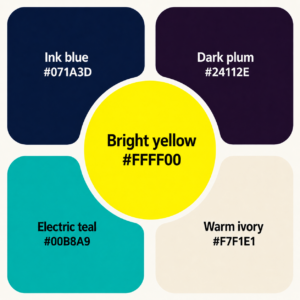
To make bright yellow look even more vivid, pair it with dark, muted, or neutral colors and use it as a focused accent rather than surrounding it with other highly saturated hues.
You can extract the color codes from an image with a bright yellow color scheme using Quillbot’s free Color Palette Generator tool.
Key takeaways
Bright yellow is a highly saturated, vivid color that feels energetic, optimistic, and attention-grabbing.
In branding, bright yellow can help logos, packaging, and campaign visuals feel bold, cheerful, urgent, and easy to notice.
For maximum impact, pair bright yellow with dark, muted, or neutral colors.
From consultants and tutors to event planners, real estate agents, and market sellers, business builders need a range of promotional cards to help them connect with clients and customers in their local communities.
Read on to find out how you can use thank you card templates in an online tool like Quillbot’s free card templates to create branded designs that leave a lasting impression.
Business analyst (BA) roles can look very different from one company to another. Some focus on data analysis and reporting, while others center on operations, compliance, systems implementation, or digital transformation.
Because of this, there’s no single “perfect” business analyst resume. Recruiters still expect a core set of analytical, communication, and problem-solving skills, but the right keywords, tools, and experience depend heavily on the role itself.
This guide explains what to include in a business analyst resume, what recruiters actually want to see, and how to tailor your resume for Applicant Tracking Systems (ATS) screenings and different business analyst specializations. The resume examples at the end show how these strategies work in practice.
TipFormatting your resume is time-consuming. With Quillbot’s Resume Templates, you can focus on tailoring your skills and experience instead of worrying about layout and margins.
Key takeaways
Business analyst roles vary widely depending on the industry and organization, so there is no single perfect resume.
Tailor your resume to the role. Use keywords, tools, and terminology that match the job description and business analyst specialization.
Focus on business impact, not responsibilities alone. Strong resumes show measurable outcomes such as cost savings, efficiency gains, or successful project delivery.
Entry-level resumes should emphasize transferable skills and project work, while senior resumes should highlight complex initiatives, stakeholder management, and measurable delivery.
Behavioral interview questions ask you to describe how you handled a specific work situation in the past. They often start with a phrase like “Tell me about a time …” and are sometimes called STAR interview questions or competency-based interview questions.
When interviewers ask behavioral-based interview questions, they’re typically looking for evidence of your soft skills, such as how you communicate, approach challenges, prioritize tasks, and collaborate with others.
This article includes example behavioral interview questions and answers, as well as tips on how to prepare for them and a list of common mistakes.
QuillBot’s free AI Chat can help you prepare for interviews by identifying relevant stories from your work experience that you can use to answer behavioral questions.
Key takeaways
Behavioral interview questions are designed to uncover how you’ve handled real workplace situations, especially around soft skills like communication, teamwork, problem-solving, leadership, and adaptability.
Strong answers use a clear structure like STAR or CAR to explain the situation, your specific actions, and the result without adding too much background.
You don’t need to memorize dozens of answers. Preparing around five flexible work stories can help you respond confidently to a wide range of behavioral questions.
The best responses show evidence of your skills instead of simply describing them, so focus on concrete examples, positive outcomes, and what you learned.